Pinocchio is hanged by the Assassins and rescued by the Fairy
The Adventures of PinocchioPinocchio is hanged by the Assassins and rescued by the Fairy at the point when his reckless refusal to heed advice appears to have become fatal. The episode turns a comic escape into a sustained pursuit, then makes rescue depend on the intervention of the Fairy with Azure Hair, who sees him hanging from a Giant Oak Tree and sends help. Its sharp change from danger to reprieve makes the cost of Pinocchio’s defiance unmistakable without closing off the possibility that someone may yet come to his aid.
Causes and First Attack
The pursuit follows Pinocchio’s refusal to take the Talking Cricket’s advice. Once back on the road, Pinocchio recognizes that ignoring warnings may bring misfortune, but immediately dismisses the Assassins as inventions used by parents to frighten children who run away at night. He imagines that, if he meets them, he can intimidate them or simply outrun them. The scene’s irony is direct: the threat he has just waved away is already close behind him.
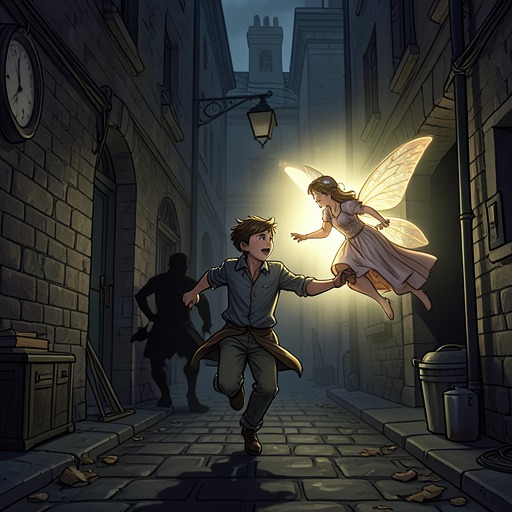
Two dark figures wrapped from head to foot in black sacks leap out of the darkness. Pinocchio has no time to hide the four gold pieces, so he stuffs them under his tongue. The Assassins seize him and demand his money or his life. When they cannot force his mouth open, one draws a long knife and tries to pry it apart. Pinocchio bites the attacker’s hand and spits it out, only to discover that what he has torn off is a cat’s paw. The reveal turns the masked attackers’ menace into something grotesque, but it does not make them less dangerous: Pinocchio breaks free, and they resume the chase.
Flight Across the Countryside
Pinocchio runs through the fields with the Assassins close behind. After about seven miles, nearly exhausted, he climbs a giant pine tree to escape them. They try to follow but slip and fall; rather than give up, they gather wood at the tree’s foot and set it alight. As the flames climb and the tree begins to burn, Pinocchio jumps down to avoid being roasted and runs again. Each attempted refuge becomes a fresh danger, and his escape depends on movement rather than a safe place to hide.
At dawn, a deep pool of muddy, coffee-colored water blocks the path. Pinocchio leaps across it; the Assassins misjudge the distance and splash into the middle. He laughs at their soaking, but when he looks back, they are still pursuing him, their black sacks dripping with water. The brief apparent reversal changes nothing about the chase. Pinocchio then sees a small white cottage among the trees and thinks reaching it may save him. He darts toward it, but the Assassins catch up before he can get inside.
Hanging from the Giant Oak Tree
The Assassins decide there is nothing left to do but hang Pinocchio. They tie his hands behind his shoulders, loop a noose around his neck, throw the rope over a high limb of the Giant Oak Tree, and pull him up until he hangs in the air. They sit on the grass and wait for him to die. After three hours, however, his eyes are still open, his mouth remains shut, and his legs continue to kick. The attackers leave, taunting him that they will return in the morning and expect to find him dead.
Their departure does not end Pinocchio’s danger. A wild wind rises, rocking him to and fro like a bell’s hammer. The movement makes him seasick, while the tightening noose chokes him and a film gradually covers his eyes. The story lingers on the physical consequences of the hanging rather than presenting it as a momentary threat: Pinocchio’s body is suspended, battered by the wind, and losing consciousness. As death approaches, his thoughts turn to his father, Geppetto. His faint appeal to his father is his last utterance before he closes his eyes, opens his mouth, stretches out his legs, and hangs as if dead.
The Fairy’s Rescue
Pinocchio is saved because the Fairy with Azure Hair looks out of her window and sees him helplessly blown about by the wind. The narration presents her response as an act of pity: she claps her hands three times, summoning a Falcon. She identifies the hanging Marionette and orders the bird to break the knot with its strong beak, lower him, and lay him on the grass at the foot of the oak. The Falcon carries out the task and reports that Pinocchio seemed dead at first, but sighed and spoke faintly as soon as the noose was loosened. The small sign of life overturns the apparent finality of his stillness.
The Fairy then summons her Poodle, Medoro, and orders him to fetch her best coach. He is to find the half-dead Marionette on the grass, lift him tenderly onto the cushions, and bring him to her. The rescue therefore proceeds in distinct stages: the Falcon cuts Pinocchio down, and Medoro is dispatched to carry him away from the tree. The Fairy also calls three doctors to determine whether Pinocchio is alive or dead. The event ends not with Pinocchio’s recovery fully settled, but with his removal from immediate peril and his condition placed in the hands of the Fairy and her summoned attendants.
Consequences and Narrative Significance
The episode gives concrete form to the danger Pinocchio had treated as imaginary. His own reflection on the road—followed by the Assassins’ sudden appearance—sets up the contrast between boasting that he can manage any threat and being caught, pursued, and nearly killed. The sequence also gives the chase a grim progression: attack, escape, renewed pursuit, forced flight from fire, and capture at the oak. Each temporary advantage proves insufficient until help arrives from outside Pinocchio’s efforts.
The rescue introduces the Fairy as a powerful and compassionate presence in the forest. The Falcon’s reverence identifies her as a Fairy who has lived in the vicinity for more than a thousand years, while her commands show her acting decisively to save Pinocchio. Later, after a schoolmate is gravely injured, Pinocchio recalls the warnings he ignored and recognizes that the boys were a bad influence and that he had stubbornly acted as he pleased. That later remorse gives this earlier disaster a place in a continuing pattern: warnings precede consequences, but danger and suffering do not prevent the story from leaving room for recognition, help, and change.